
Estimated Tax Payments Guide 2026: Everything You Need to Know About Quarterly Taxes
Last spring, a freelance graphic designer named Maria called our office in a panic. "I just filed my taxes and I owe $8,000," she said. "Plus the IRS is charging me a penalty for not paying throughout the year. Nobody told me I was supposed to make quarterly payments!"
Maria's not alone. This happens often. Someone goes independent, starts freelancing, or launches a side business. No one tells them they need to pay taxes four times a year, not just once. Then April rolls around and boom: huge tax bill plus penalties.
If you're self-employed, freelancing, running an Uber on the side, or earning income without taxes being withheld, you need to understand estimated tax payments. Miss them and you'll pay penalties. Overpay and you're giving the government an interest-free loan. Get them right and tax season becomes way less stressful.
This guide covers who needs to make quarterly estimated payments in 2026, how to calculate what you owe, when to pay, and how to avoid those annoying underpayment penalties.
Table of Contents:
What Are Estimated Tax Payments?
Who Needs to Make Quarterly Estimated Payments?
How to Calculate Your Estimated Tax Payments
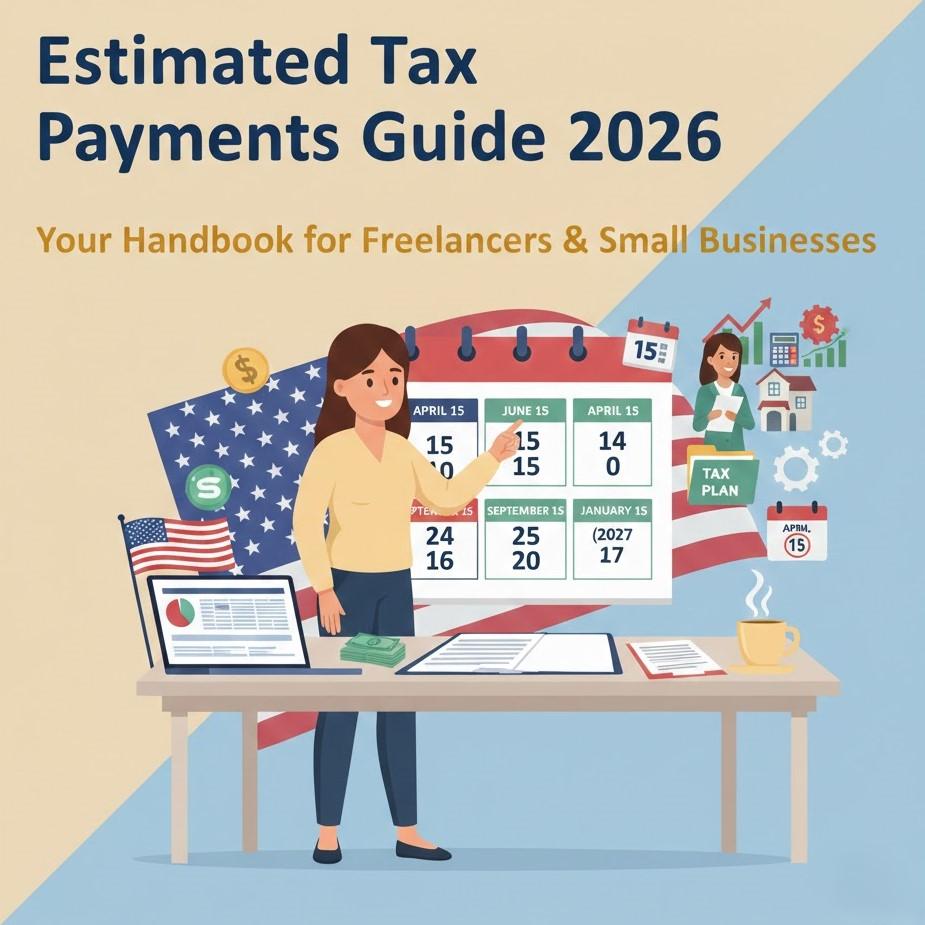
Quarterly Tax Deadlines for 2026
Understanding the Safe Harbor Rule
Form 1040-ES: Your Estimated Tax Worksheet
Payment Methods and Options
Avoiding Underpayment Penalties
Special Situations and Exceptions
Tips for Freelancers and Independent Contractors
Frequently Asked Questions
What Are Estimated Tax Payments?
The US tax system runs on "pay as you go." The IRS wants money throughout the year as you earn it, not in one lump sum when you file your return in April.
For regular W-2 employees, this happens automatically. Your employer withholds federal income tax, Social Security, and Medicare from every paycheck and sends it to the IRS. You never see that money - it goes straight to Uncle Sam.
But what if nobody's withholding taxes for you? What if you're:
Running your own business
Freelancing or doing contract work
Driving for Uber or delivering for DoorDash
Renting out property
Making decent money from investments
Have a side hustle on top of your day job
That's where estimated tax payments come in. Think of them as DIY withholding. Instead of an employer taking money out of your paycheck, you calculate how much you owe and send it to the IRS yourself, four times a year.
Why Quarterly Instead of Once a Year?
The government doesn't want to wait until April 2027 to get the taxes you owe on 2026 income. They want it now. More practically, it helps you avoid that stomach-dropping moment when you realize you owe $15,000 and have to come up with it all at once.
Spreading payments across four quarters makes budgeting easier. You pay roughly a quarter of your annual tax bill every three months instead of scrambling for the full amount in April.
What Taxes Get Paid Through Estimates?
Your quarterly payments should cover:
Federal income tax - Based on your tax bracket and expected income
Self-employment tax - This is the big one that surprises people. About 15.3% of your net self-employment income goes to Social Security and Medicare. When you have an employer, they pay half (7.65%) and you pay half (7.65%). When you're self-employed, you pay both halves.
Alternative Minimum Tax - If it applies to you (rare for most people)
You'll also need to make separate estimated payments to your state if you live somewhere with state income tax. California, for example, has its own quarterly payment system with rates that can hit 13.3% for high earners.
Who Needs to Make Quarterly Estimated Payments?
Not everyone needs to bother with quarterly payments. Here's how to know if you do.
You Definitely Need to Make Estimated Payments If:
You're self-employed. Doesn't matter if you're a freelance writer, consultant, web developer, plumber with your own business, or selling handmade goods on Etsy. If you're running a business where clients aren't withholding taxes, you need quarterly payments.
Our firm works with tons of self-employed people. Everyone from photographers to tutors to Airbnb hosts. They all make estimated payments (or should be).
You're getting 1099-NEC forms. That's the form showing nonemployee compensation. Get a few of these and the IRS expects quarterly payments.
You're in the gig economy. Uber, Lyft, DoorDash, Instacart, TaskRabbit—all self-employment income. The apps might make it feel like a job, but tax-wise, you're an independent contractor.
You have rental income. Own a rental property or two? That income needs estimated payments unless you have enough withholding from a regular job to cover it.
You're making serious money from investments. Sold some stock and realized big capital gains? Have dividend income? Interest income? If it's substantial and you don't have withholding covering it, make estimated payments.
The Actual IRS Rule
Here's the technical requirement: You need estimated payments if you expect to owe at least $1,000 when you file your return, after subtracting any withholding and credits.
Example: Your total tax for 2026 will be $18,000. You have a part-time job where $6,000 gets withheld. That means you'll owe $12,000 when you file. Since $12,000 is way more than $1,000, you need quarterly payments.
You're Probably Fine Without Them If:
You're a regular W-2 employee with adequate withholding and no significant other income. Your employer handles everything.
Your withholding covers your full tax bill. Even if you have some freelance income on the side, if your main job's withholding is enough to cover all your tax, you're good.
You owe less than $1,000 total. The IRS doesn't care about small amounts.
The Gray Areas
What if I have both W-2 and self-employment income? This is super common. You work a regular job but also freelance on weekends, or you have a side business. You might not need separate estimated payments if your W-2 withholding covers everything.
One option: increase your W-4 withholding at your main job to cover the self-employment tax. Sometimes that's easier than dealing with quarterly payments. File a new W-4 with your employer asking them to withhold an extra $X per paycheck.
What if my income bounces around? Welcome to freelancing! If you don't know what you'll make this year, start with last year's numbers (more on that "safe harbor" thing later) or make your best guess and adjust as you go.
I just started my business in August. What now? Make payments for the remaining quarters. Started in August? Pay for third quarter (September 15 deadline) and fourth quarter (January 15, 2027 deadline).
How to Calculate Your Estimated Tax Payments
This is where people get nervous, but you have options ranging from simple to precise.
Method 1: The Easy Way (Last Year's Tax)
This is the safest method, especially if your income doesn't swing wildly year to year.
Here's what you do:
Pull out your 2025 tax return
Find "Total Tax" (line 24 on Form 1040)
If your 2025 AGI was under $150,000, that's your number
If your 2025 AGI was over $150,000, multiply by 1.1 (so 110%)
Subtract any withholding you'll have from a W-2 job this year
Divide what's left by 4
That's your quarterly payment.
Example:
2025 total tax: $22,000
2025 AGI: $95,000 (under $150k)
2026 W-2 withholding: $0 (fully self-employed)
Quarterly payment: $22,000 ÷ 4 = $5,500
Even if you crush it in 2026 and end up owing $30,000, you won't get penalties because you paid 100% of last year's tax. That's the "safe harbor" rule we'll talk about more in a minute.
Method 2: The Accurate Way (Estimate This Year)
This takes more work but gives you a better picture of what you'll actually owe.
You need to estimate:
Total income for 2026 from all sources
Business expenses if self-employed
Deductions (standard deduction for 2026 is $16,100 single, $32,200 married)
Your tax using the 2026 brackets
Self-employment tax if applicable (roughly 15.3% of 92.35% of your net profit)
Then subtract any withholding and divide by 4.
Quick example:
Self-employment income: $90,000
Business expenses: $20,000
Net profit: $70,000
Standard deduction: $14,600
Taxable income: $55,400
Federal income tax: around $7,500 (using 2026 brackets)
Self-employment tax: $70,000 × 0.9235 × 0.153 = $9,886
Total tax: $17,386
Quarterly payment: $4,347
Method 3: The Annualized Way (Uneven Income)
Some businesses are seasonal. Maybe you're a retail business that makes most money in Q4, or a tax preparer who makes bank in Q1 and Q2 but not much the rest of the year.
The annualized income method lets you match payments to when you actually earn money. It's complicated and requires Form 2210 Schedule AI when you file, but it can save penalties if your income is really lumpy.
Most people should stick with Method 1 or 2.
Don't Forget State
California, New York, and most other states want their quarterly payments too. California's calculation is similar to federal but uses California tax rates (which top out at 13.3% for high earners -ouch).
For a lot of self-employed Californians, state quarterly payments nearly match federal payments.
Form 1040-ES
The IRS publishes Form 1040-ES every year with worksheets and payment vouchers. Download it from irs.gov. It walks you through the calculations and gives you the current year's tax tables.
Quarterly Tax Deadlines for 2026
The quarters aren't actually equal, which trips people up.
2026 Federal Deadlines
First Quarter (covers January 1 - March 31)
Due: April 15, 2026
Second Quarter (covers April 1 - May 31)
Due: June 16, 2026 (June 15 is Sunday)
This quarter is only two months. Weird, but that's how the IRS does it.
Third Quarter (covers June 1 - August 31)
Due: September 15, 2026
Fourth Quarter (covers September 1 - December 31)
Due: January 15, 2027
There's a shortcut for the fourth quarter: if you file your complete return by January 31, 2027, and pay everything you owe, you can skip the January 15 payment.
State Deadlines
Most states use the same schedule. California does. Check your state's revenue website to confirm.
What If You're Late?
You'll owe an underpayment penalty, which is basically interest on the money you should have paid but didn't. The penalty accrues from the due date.
Missing one deadline isn't the end of the world, but don't let it become a habit. Each quarter is evaluated separately, so if you miss Q1, at least get Q2, Q3, and Q4 in on time.
Set Reminders
Put these dates in your phone with alerts a week early. Seriously. Set a recurring reminder for April 10, June 10, September 10, and January 10. That week buffer gives you time to actually make the payment without last-minute panic.
Understanding the Safe Harbor Rule
This is one of the most important concepts for estimated taxes. Get this and you'll stress way less.
What Is Safe Harbor?
Safe harbor protects you from penalties for underpayment. You won't face these penalties if you meet certain requirements, even if you don't pay enough estimated tax.
Two ways to get safe harbor protection:
Option 1: Pay 90% of your current year tax
If your total payments (estimated plus any withholding) equal at least 90% of your actual 2026 tax, no penalty. You'll owe the other 10% when you file, but no penalty for underpayment.
Option 2: Pay 100% of last year's tax (or 110% if high income)
Pay at least what you paid in 2025 and you're golden, even if 2026 turns out way different.
The 110% rule kicks in if your 2025 AGI topped $150,000 (or $75,000 if married filing separately).
Why This Matters
Say you paid $28,000 in total tax on your 2025 return. For 2026, you pay $28,000 in estimated payments spread across four quarters.
Now suppose your business explodes and your actual 2026 tax ends up being $45,000. You'll owe the extra $17,000 when you file, but zero penalties because you met safe harbor.
That's huge! You can't perfectly predict income, especially if you're self-employed or in a commission-based job. Safe harbor gives you protection even when estimates are way off.
When Safe Harbor Doesn't Help
If you had zero tax liability last year (maybe you just started your business), you can't use the prior year safe harbor. You'll need to estimate your current year accurately and hit at least 90%.
Also, safe harbor doesn't eliminate the tax you owe—just the penalties. You still have to pay the full amount eventually.
State Safe Harbor
Most states have similar provisions. California follows the same safe harbor rules as federal. Always confirm your specific state's requirements.
Form 1040-ES: Your Estimated Tax Worksheet
Form 1040-ES is specifically designed for estimated payments. Let's look at what's inside.
What's In It
The worksheet - Multi-page calculation guide that walks you through estimating your tax. Asks for expected income, deductions, credits, and calculates what you should pay quarterly.
Payment vouchers - Four vouchers you can mail with checks if you're old school. Each has space for your info and payment amount.
Instructions - Detailed explanations and current year tax tables.
Using the Worksheet
You'll enter:
Expected income from all sources
Expected deductions (standard or itemized)
Calculation of income tax based on current brackets
Self-employment tax if applicable
Any credits you expect
Withholding from W-2 jobs
The result: how much you need to pay quarterly
The worksheet does the math for you once you plug in the numbers.
When to Recalculate
Don't treat your January estimate as set in stone. If things change - you land a huge client, lose a major account, have unexpected expenses, whatever - recalculate and adjust your remaining payments.
Let's say you estimated $80,000 income in January but by June you've already made $100,000 and business is booming. Recalculate using the higher number and increase your Q3 and Q4 payments.
It's totally fine (and smart) to adjust as you go. Better than stubbornly sticking to wrong numbers and owing big in April.
State Forms
California has Form 540-ES. New York has IT-2105. Download your state's form from their revenue department website.
Payment Methods and Options
You've got choices for how to actually send money to the IRS.
IRS Direct Pay (Free and Easy)
Go to irs.gov/payments. It's free and takes about 5 minutes.
Select "Estimated Tax" as payment type
Choose tax year and which quarter
Enter bank routing and account number
Schedule payment for today or a future date
You can schedule payments up to a year in advance. Some people schedule all four quarterly payments in January and forget about it.
Our firm recommends this for most clients. It's free, fast, and you get instant confirmation.
EFTPS (Electronic Federal Tax Payment System)
Another free option. You enroll at eftps.gov (takes about a week to get your PIN in the mail), then you can:
Schedule payments in advance
View payment history
Make payments anytime
Get email confirmations
EFTPS is great if you're making payments for multiple people or entities (like if you run a business and need to pay payroll taxes too). For personal estimated taxes only, Direct Pay is simpler.
Credit or Debit Card
You can pay by card through IRS-approved processors, but they charge fees:
Debit card: around $2-3 flat fee
Credit card: roughly 2% of payment amount
Do the math. Paying $5,000 with a credit card costs $100 in fees. Unless your credit card rewards are worth more than $100, don't bother.
Some people use cards for the float (make payment, have a month to pay the card off) but that's risky if cash flow is tight.
Check or Money Order
Old school but still works. Use the payment vouchers from Form 1040-ES, make the check out to "United States Treasury," and mail to the address listed for your state.
Give yourself plenty of time—payments postmarked by the deadline count as on time, but mail can be slow.
State Payments
California has Web Pay, similar to IRS Direct Pay. Most states offer free online payment. Check your state revenue website.
Which Method to Use
For most people: IRS Direct Pay. It's free, fast, and simple.
Use EFTPS if you want detailed payment tracking or are making multiple types of payments.
Skip credit cards unless the rewards legitimately outweigh the fees.
Skip checks unless you really prefer paper or have no reliable internet access.
Avoiding Underpayment Penalties
The underpayment penalty is interest charged for not paying taxes when they were due. Here's how to avoid it.
How the Penalty Works
The IRS calculates how much you should have paid each quarter and charges interest on any shortfall, from the due date until you actually paid (or until you filed your return, whichever is earlier).
The interest rate changes but hovers around 8% annually as of early 2026. The calculation is quarterly and gets complicated, but the IRS does it for you. If you underpaid, you'll see Form 2210 showing the penalty when you file.
Typical Penalty Amounts
Underpay by $5,000 evenly across all quarters? Penalty might be $200-300 for the year.
Completely ignore estimated payments and owe $25,000 with no withholding? Penalty could hit $1,000-1,500 or more.
Not catastrophic, but certainly avoidable with proper planning.
How to Avoid It
Meet safe harbor - Pay 90% of current year tax or 100%/110% of prior year tax.
Make timely quarterly payments - Don't skip quarters planning to catch up later. Each quarter is tracked separately.
Increase W-4 withholding if you have a day job - Withholding is treated as paid evenly throughout the year even if it's not, which can help avoid penalties. If you get a year-end bonus and have extra tax withheld, it retroactively counts as if you paid it all year.
Adjust if income changes - Earning more than expected? Increase remaining payments. Earning less? You can decrease them.
Penalty Waivers
The IRS might waive penalties if:
Casualty, disaster, or unusual circumstances caused the underpayment
You retired after age 62 or became disabled during the tax year
The underpayment was for reasonable cause
Request a waiver using Form 2210 when you file and explain why you qualify.
Don't Stress Too Much
If you underpay a bit, the penalty isn't huge for most people. Obviously try to avoid it, but if it happens, it's not the end of the world. Pay what you owe, learn from it, and get the next quarter right.
Special Situations and Exceptions
Some situations need special handling.
Farmers and Fishermen
If at least two-thirds of your income comes from farming or fishing, you only have to make one payment (by January 15, 2027) instead of four. Or file your return by March 1 and pay in full, skipping estimated payments entirely.
Safe harbor for farmers/fishermen is 66.67% of current year tax instead of 90%.
High Income ($150k+ AGI)
Your safe harbor is 110% of prior year tax, not 100%. This catches people off guard.
Last year's tax was $40,000 and your AGI was $200,000? You need to pay $44,000 (110% of $40,000) to meet safe harbor, not $40,000..
Started Self-Employment Mid-Year
Only make payments for the quarters remaining. Started your business in July? Make third and fourth quarter payments.
Lost Income Mid-Year
Recalculate and adjust remaining payments down. There's no penalty for changing course.
W-2 Plus Side Business
Super common. You have a regular job with withholding plus a side gig.
Options:
Make separate estimated payments for the side income
Increase W-4 withholding at your main job to cover it
Mix of both
Option 2 is often easier since withholding is treated as paid evenly all year, which helps avoid penalties.
Household Employers
Hire a nanny or housekeeper and pay them over $2,800 in 2026? You might need estimated payments for household employment taxes if you don't have enough withholding elsewhere.
Tips for Freelancers and Independent Contractors
Our firm works with tons of freelancers. Here's what makes estimated payments easier.
Set Aside Money Immediately
This is the #1 most important habit. Every time you get paid:
Instantly transfer 25-30% to a separate savings account
Label that account "Taxes" mentally or literally
Don't touch it except to pay quarterly taxes
If you wait until the deadline to find out where the money will come from, you will create stress and possible cash flow problems.
One client opened a separate high-yield savings account called "IRS Money." Every client payment, 30% goes straight there. When April, June, September, and January roll around, the money's waiting.
Track Everything All Year
Don't wait until December to calculate income and expenses. Use QuickBooks, FreshBooks, Wave, or even just a spreadsheet to track:
Income received
Business expenses paid
Mileage for business driving
Home office percentage if you have one
Knowing your numbers in real time makes calculating quarterly payments way easier.
Consider Paying Monthly
The IRS requires quarterly payments, but nothing stops you from paying monthly or even with each big project.
Some freelancers prefer smaller, more frequent payments because:
Less painful than big quarterly chunks
Keeps the tax savings account from building up (less temptation)
Smoother cash flow
You can make payments whenever you want through Direct Pay or EFTPS. Just make sure you've paid enough by each quarterly deadline.
Separate Business and Personal Money
Open a separate checking account for business income and expenses, even if you're a sole proprietor. This doesn't require forming an LLC or anything formal - just a second personal account you use only for business.
Mixing business and personal finances makes tracking income nearly impossible. Separate accounts make it obvious what you earned and spent.
Remember Self-Employment Tax
This blindsides new freelancers. Self-employment tax is roughly 15.3% of your net profit, in addition to regular income tax.
If you're in the 22% federal bracket, live in California with a 9.3% state rate, and have self-employment income, you're looking at:
22% federal income tax
15.3% self-employment tax
9.3% California state tax
Total: Nearly 47% in taxes
Obviously deductions reduce this, but when setting money aside, plan on 30-35% of revenue going to taxes. Better to over-save slightly than under-save.
Review Quarterly
End of each quarter, look at year-to-date numbers:
Am I earning more or less than expected?
Are expenses higher or lower?
Should I adjust remaining payments?
This quarterly check-in keeps you on track and prevents April surprises.
Get Professional Help
If quarterly estimates stress you out, or your situation is complex, hire a CPA or enrolled agent. We calculate quarterly payments for tons of freelance clients. They pay a small quarterly fee for peace of mind and accurate calculations.
Better than guessing wrong and owing penalties or massively overpaying and giving the IRS an interest-free loan.
Frequently Asked Questions
What happens if I miss a quarterly deadline?
Pay as soon as you realize you missed it. You'll owe penalty for that quarter, but paying stops it from growing. Don't skip future quarters thinking you've already messed up -each quarter counts separately.
Can I pay more early in the year and less later?
Not really. The IRS expects relatively equal payments across quarters (or payments that match when you earned the income if using the annualized method). Front-loading doesn't protect you from penalties on later shortfalls.
I got a big refund last year. Does that mean I paid enough?
Not necessarily. A refund means you overpaid total tax, but you might still owe underpayment penalty if you didn't pay enough throughout the year. The penalty is calculated separately from your refund.
Should I make estimated payments or just increase W-4 withholding?
If you have both a W-2 job and self-employment income, increasing W-4 withholding is often simpler. But if you're fully self-employed with no withholding to increase, estimated payments are your only option.
What if I overestimate and pay too much?
You get it back as a refund when you file. There's no penalty for overpaying.
Do I need state estimated payments too?
If your state has income tax, yes. Deadlines usually match federal.
Can I deduct estimated tax payments?
No. They're not deductible - they're payments toward your liability. But actual state income tax paid (not the estimated payments, but the actual tax) may be deductible on federal if you itemize, subject to the $40,000 SALT cap.
My income varies wildly quarter to quarter. What do I do?
Consider the annualized income method, which lets you match payments to actual income each period. Requires Form 2210 Schedule AI when filing.
I'm starting a business this year and have no idea what I'll make.
Make your best guess based on your business plan. You can adjust as the year goes on. Start conservative and increase payments if you're doing better than expected.
How long do I have to make these payments?
As long as you have income without adequate withholding. Many self-employed people make quarterly payments their entire careers.
Next Steps: Taking Control of Your Quarterly Payments
Estimated tax payments feel overwhelming at first, but with a system, they become routine.
Step 1: Figure out if you need them
Review your income sources. Self-employed? Freelancing? Significant non-wage income? You probably need quarterly payments.
Step 2: Calculate your amount
Use Form 1040-ES or work with a tax pro to determine quarterly amounts. If unsure, use the safe harbor method (100% of prior year tax).
Step 3: Set reminders
Mark April 15, June 16, September 15, and January 15 in your calendar. Set alerts a week early.
Step 4: Create a savings system
Open a separate savings account for taxes. Move 25-30% of every payment into it immediately.
Step 5: Pick a payment method
Set up IRS Direct Pay or EFTPS. Consider scheduling all payments in advance if income is predictable.
Step 6: Review quarterly
End of each quarter, check your numbers and adjust future payments if needed.
Step 7: Keep records
Track income and expenses all year. Makes calculating estimates easier and keeps you ready for annual filing.
Step 8: Get help if you need it
If you're unsure about calculations or your situation is complex, work with a CPA or EA. Professional guidance usually costs less than penalties or mistakes.
Conclusion
Estimated tax payments are just part of self-employment life. Once you set up a system, it becomes routine. Set aside money with each payment. Mark deadlines in your calendar. Make payments on time.
The key is staying proactive. Don't wait until April to think about taxes for the year. Handle quarterly payments as you go, save money consistently, and adjust when income changes.
Remember Maria from the beginning? After that costly surprise, she set up a system. Now, 30% of every client payment goes to her tax savings account. She has calendar reminders that repeat, and she works with our firm to calculate payments every quarter. She hasn't had a surprise tax bill or penalty since.
You can do the same. Take control of quarterly obligations now, and you won't face a massive bill and penalties next April.
Need help calculating your estimated tax payments? Our team specializes in helping freelancers, independent contractors, and self-employed professionals navigate quarterly taxes. Contact us for personalized guidance.
Welfo Accounting & Tax Services
Expert Guidance for Self-Employed & Independent Contractors
📞 Phone: (279) 999-2788
📧 Email: info@welfo.us
🌐 Website: https://welfo.us
Disclaimer: This article provides general information and should not be considered tax advice. Tax laws change regularly, and individual circumstances vary. Consult with a qualified tax professional about your specific situation.